Tsingy de Bemaraha National Park

Tsingy de Bemaraha National Park protects the largest forest of limestone pinnacles on earth, a field of razor-edged grey needles rising up to around 100 metres above western Madagascar. Visitors cross it on harnesses and fixed cables, with circuits running from a gentle two-hour walk to a demanding five-hour via ferrata route. The park sits in the Melaky region near Bekopaka, reachable only in the dry months and listed by UNESCO since 1990.
Grand Tsingy Trekking Safaris on the Andamozavaky Circuit
The Andamozavaky trekking safari is the reason people make this trip, and it is unlike any other walk in Madagascar. The route runs roughly 5.6 km over four to six hours, though distance tells you almost nothing about the effort. You start at the base of the massif, thread through tunnels and crevices at ground level, then climb vertical ladders bolted into the rock until you emerge on top of the pinnacle field.
Fixed steel cables run the length of the exposed sections. You clip a harness to them and stay clipped. Suspension bridges span the gaps between rock towers with a long drop beneath, and the crossings are the part most people remember, for better or worse. Anyone with a serious fear of heights or difficulty in tight spaces should think hard before booking this circuit rather than discovering the problem halfway up a ladder.
What you get at the top is a view over several square kilometres of stone spikes running to the horizon. Guides are trained in the safety system and the park issues gloves, which are compulsory. The rock is genuinely sharp enough to open a hand that grabs it bare.
There is no phone coverage in the park and the nearest hospital is many hours away by road. Carry at least four litres of water per person, wear closed shoes with real grip, and treat the guide’s briefing as a safety briefing rather than a formality. Metal ladders get hot enough to burn hands by late morning.
Petit Tsingy Walking Tours Near Bekopaka
Petit Tsingy walking tours cover a smaller field of pinnacles close to Bekopaka and take about ninety minutes to two hours. No harness is needed. There are a few ladders and some scrambling, but nothing approaching the Grand Tsingy in exposure or commitment.
This is the sensible option for anyone not up to the via ferrata, and it is also worth doing in its own right if you have the time for both. The viewpoint looks out over the Manambolo River and the wider massif. Wildlife is often better here than on the Grand circuit, since the surrounding dry forest holds Decken’s sifaka families that are seen far more reliably than anything on the exposed rock above.
Grand Tsingy. Four to six hours, harness and via ferrata, vertical ladders, suspension bridges and narrow tunnels. Needs moderate fitness and a head for heights. A 45-minute drive north of Bekopaka on rough track. The main event.
Petit Tsingy. Ninety minutes to two hours, no harness required, close to the village. Some ladders but manageable for most reasonably mobile visitors. Better odds on lemurs. Works well as a half day paired with the river gorge.
Manambolo River Gorge Pirogue Trips and Vazimba Caves
Pirogue trips along the Manambolo gorge fill a half day and give the park an entirely different character. Two-person dugout canoes, poled by local boatmen, run below limestone walls that rise vertically for around 100 metres.
The gorge holds burial sites belonging to the Vazimba, described in Malagasy tradition as the island’s first inhabitants, placed in ledges and cavities high in cliffs that look unreachable from the water. Caves along the route contain old markings. Nile crocodiles live in the river, watched for by the boatmen and rarely seen by anyone else.
Book this ahead in peak season, since the number of pirogues and polers is limited and they do run out. Mornings are calmer and cooler than afternoons on the water.
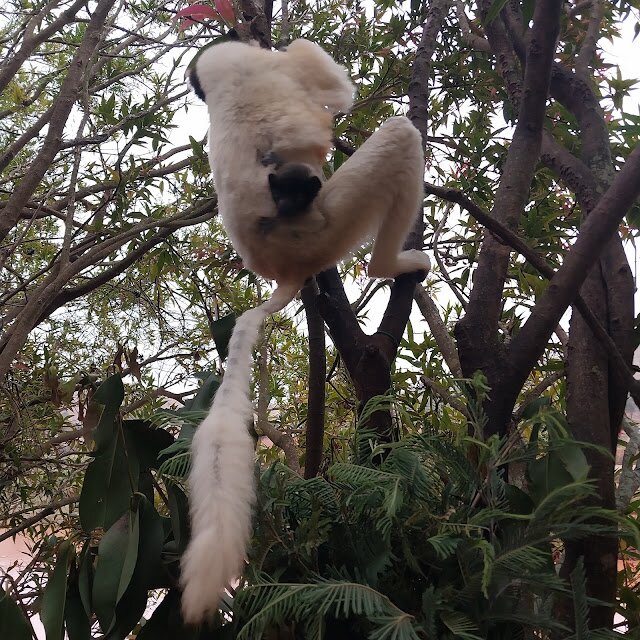
Decken’s Sifaka and Wildlife Watching Tours in the Tsingy
Wildlife watching tours here turn up eleven lemur species, and the terrain does something unusual to how you see them. Decken’s sifaka, white-furred with a dark face, moves across the pinnacle tops and along the forest edge, and watching one cross razor limestone without apparent concern is among the odder sights in Madagascar.
Red-fronted brown lemurs and western woolly lemurs are also present, along with nocturnal species in the surrounding dry forest. Fossa live in the park and are seen very rarely. Reptiles do well in this habitat: leaf-tailed geckos flatten themselves against bark and stone, and the Madagascar giant gecko turns up on rock faces and buildings.
Roughly 85 percent of the plants and animals recorded at Bemaraha are found nowhere else. The summit, the slope and the base of a single limestone needle each hold different species.
Go early. Wildlife activity drops sharply once the rock starts absorbing heat, and by mid-morning most of what you might have seen has gone into shade.

Birding Tours in the Bemaraha Dry Forest
Birding tours in the western dry forest surrounding the tsingy have recorded over 100 species. The habitat is deciduous, dominated by Dalbergia and Commiphora, and it is one of the most threatened forest types in Madagascar, which gives the birding here a certain urgency.
Madagascar fish eagles work the Manambolo, and the crested ibis is among the sought-after species in the forest sections. Early morning walks around Bekopaka and along the lower trails are more productive than anything on the exposed massif, where bird activity is thin.
Most visitors come for the rock rather than the birds, so bird-focused guiding takes arranging in advance rather than at the gate.
Avenue of the Baobabs and Kirindy on the Tsingy Tour Route
The road north from Morondava passes two places that most operators build into a Tsingy tour by default. The Avenue of the Baobabs sits early on the route, and the standard pattern is to catch it at sunrise heading out or sunset coming back.
Kirindy Reserve lies further along and protects dry deciduous forest with a genuine reputation for fossa sightings, which are difficult almost everywhere else. Adding a night there turns a Tsingy run into a fuller western circuit of around seven nights. Belo sur Tsiribihina, where the ferry crosses, is the usual lunch stop.

Getting to Tsingy de Bemaraha from Morondava
Access is the defining fact of this park. Bekopaka lies roughly 200 to 230 km north of Morondava, and that stretch takes somewhere between six and ten hours depending on conditions. A high-clearance 4×4 with an experienced driver is not a recommendation but a requirement. Standard vehicles do not make it.
Two river ferries break the drive. The Tsiribihina crossing near Tsimafana comes first, and the Manambolo ferry at Bekopaka comes last. Both are simple vehicle barges, one of which departs when enough vehicles have gathered rather than to any schedule, and the Manambolo runs only until early evening. Missing it means a night on the wrong side of the water.
Most visitors fly Antananarivo to Morondava, which takes about an hour and removes several days of driving. From there, allow a minimum of three days: one out, one full day in the park, one back. Four is better and lets you do both circuits properly. Accommodation in Bekopaka runs from simple guesthouses to a handful of comfortable lodges, and everything there is more expensive than it looks, because every item on the premises came up that same road.
Best Time for a Tsingy de Bemaraha Trek
This park has a closed season, which sets it apart from every other park in this guide. From around December through March the access track floods, the rivers rise, the ferries stop and the limestone turns lethally slick. The park shuts in all but name. There is no point planning a visit in those months.
April and May. The road usually reopens somewhere in this window, though the exact date shifts year to year with the rains. Quiet, green, and worth confirming with an operator before committing to dates.
June to September. Peak season and the best conditions. Cooler temperatures make the via ferrata far more comfortable, wildlife is active, and road conditions are at their most reliable. Lodges in Bekopaka are few and fill months ahead.
October and November. Still open and still accessible, but hot. Canyon temperatures climb past 35 degrees and the exposed sections of the Grand Tsingy become hard work. Start before dawn if you travel now.
December to March. Closed in practice. Flooded roads, unusable ferries and slippery rock. Plan a different part of Madagascar for these months.
Frequently Asked Questions
How much does it cost to visit Tsingy de Bemaraha?
Entry runs at 55,000 Ariary per adult per day, higher than most Malagasy parks, with children under twelve at 30,000 Ariary. A compulsory helmet fee of 5,000 Ariary per person per day applies here and nowhere else. Guide fees are charged per group, commonly in the range of 20 to 30 euros equivalent per day, with via ferrata guides for the Grand Tsingy at the upper end. Harness hire is usually bundled into the circuit price. Everything is cash in Ariary at the gate.
What does the whole trip cost?
The park fees are a small part of it. The 4×4 and driver from Morondava is the main expense, commonly around 150 euros or more for the multi-day return run, and a flight from Antananarivo to Morondava adds roughly 200 euros each way. Lodges in Bekopaka are pricier than their comfort level suggests because of supply costs. Budget the transport first and the park second.
How fit do I need to be for the Grand Tsingy?
Moderately fit and comfortable with heights and enclosed spaces. The climbing is aided throughout by ladders, rungs and cables, so no technical skill is needed, but you will be hauling yourself up vertical sections, squeezing through narrow passages and crossing suspension bridges over a long drop. Anyone unsure should do the Petit Tsingy instead, which delivers a real sense of the place without the exposure.
Is the park ever closed?
In practice yes, roughly December through March. The access road from Morondava floods, the river ferries cannot operate reliably, and wet limestone is dangerous underfoot. Reopening usually falls somewhere in April or May depending on how the rains ended. Confirm with a local operator before booking flights around those shoulder dates.
How many days should I allow?
Three days minimum from Morondava, covering the drive out, one full day in the park and the drive back. Four days lets you split the Grand Tsingy and the Petit Tsingy across two mornings and fit in the Manambolo pirogue trip without rushing. Adding Kirindy and the Avenue of the Baobabs properly makes it a week.
Can I get there without a 4×4?
No. The track is unsealed, deeply rutted in places and includes water crossings. High clearance and four-wheel drive are needed, along with a driver who knows the route. Charter flights to the airstrip near Bekopaka exist but are expensive and complicated by the fact that aircraft cannot be left there overnight.
Is Tsingy de Bemaraha suitable for children?
The Petit Tsingy suits older children who are steady on ladders. The Grand Tsingy is not appropriate for young children given the exposure and the harness system. The bigger obstacle is the drive, which is long, hot and rough in both directions, and hard on small passengers.
Planning Your Visit
Tsingy de Bemaraha punishes loose planning more than any other park in Madagascar. Ferry timings, the state of the track, the reopening date after the rains and the small number of beds in Bekopaka all have to line up, and getting one of them wrong costs a day you cannot spare.
Booking Your Madagascar Trip
The safari companies and tour operators listed on this website put trips like this together for a living and know which camps, guides and routes actually deliver. We are an independent guide to Madagascar; we do not book or sell tours ourselves.
When you are ready, arrange your safari, tour or holiday with one of the recognised operators listed here. Tell them your dates and what matters most, and a real person, not a form, will handle the itinerary, park bookings and logistics for you.