Cost of Travelling in Madagascar

The cost of travelling in Madagascar is lower than most visitors expect on the ground and higher than they expect to arrange. Food, accommodation and park fees are inexpensive by international standards, while vehicle hire and domestic flights dominate almost every budget. Independent travellers commonly report daily spends between 45 and 150 US dollars per person, with transport rather than comfort driving most of the difference.
Where the Money Actually Goes
The single most useful thing to understand about Madagascar budgets is that transport, not accommodation, is the dominant line item. One detailed traveller account of a four-week trip recorded a total spend of roughly £5,255 for two people, of which £3,454 went on vehicle hire alone. Accommodation across the same month came to about £675.
That ratio holds across most trips. A guesthouse costs a few tens of dollars. A private four-wheel drive with a driver costs several times that every single day, whether you use it or not.
This is why the biggest saving available in Madagascar is not staying in cheaper hotels. It is choosing a route that reduces vehicle days, or using taxi-brousse for some legs, or flying instead of driving where the numbers work out.
Four weeks in Madagascar for two people: about £675 on accommodation, about £3,454 on the car. Transport is the trip, financially speaking.
Vehicle Hire and Driver Costs
A private vehicle with a driver is what most operators arrange and what most itineraries assume. It is charged per day rather than per kilometre, and the day rate applies whether you drive eight hours or sit at a park.
Four-wheel drive costs noticeably more than a standard car and is required for the western circuit to Tsingy de Bemaraha, the tracks to Andohahela‘s outer parcels, the Anjohibe caves and most remote park access. On the sealed RN7 south, a standard vehicle is often adequate.
Self-drive is possible and some travellers do it, though the combination of road conditions, police checkpoints, fuel availability and the general difficulty of navigation makes a local driver good value rather than an indulgence. Fuel is a separate cost on top of the hire rate.
National Park Fees and Guide Charges
Park fees are modest and standardised, which makes them one of the easier parts of a budget to calculate in advance. Most Madagascar National Parks properties charge the same daily rate per adult with a reduced rate for children under twelve.
A handful cost more. Tsingy de Bemaraha carries a higher entry plus a compulsory helmet fee found nowhere else. Tsingy de Namoroka and Lokobe both sit above the standard rate. Baie de Baly is substantially higher again, reflecting the boat transfers built into its circuits and the intensive protection its tortoise population requires.
Guides are compulsory in almost every park and charged separately, per group rather than per person, and priced by circuit rather than by hour. Longer or harder circuits cost more. For treks at Marojejy, Andringitra or Zahamena, add porters and often a cook, which changes the arithmetic considerably.
Everything at park offices is cash in Ariary. No cards, no online booking, no exceptions. Draw money in Antananarivo or a regional centre before heading to any park, because ATMs are scarce once you leave the main towns and nonexistent at places like Bekopaka, Manantenina or Soalala. Work out your full fees, guide charges and porter costs before you leave the last bank.
Accommodation Costs Across the Island
Accommodation spans a wide range and is good value throughout. Simple guesthouses run from around 20 to 40 US dollars a night. Comfortable mid-range hotels with pools and beachfront positions sit roughly between 50 and 120. A small number of genuinely upmarket lodges charge considerably more.
Remote places cost more than their comfort level suggests, and the reason is logistics. Everything at Bekopaka near Tsingy de Bemaraha, at the Masoala peninsula lodges or on the Nosy Be beaches arrived by boat or over a bad road, and the price reflects that rather than the quality of the room.
Nosy Be is the most expensive part of the country across every category. Antsirabe, Fianarantsoa and the highland towns are the cheapest. Camping is available inside several parks and is the lowest-cost option if you carry or hire gear.
Shoestring, around 45 to 60 dollars a day. Guesthouses, street food and local eateries, taxi-brousse between towns, one or two parks. Slow and demanding but entirely workable. Not compatible with the western circuit or remote parks.
Mid-range, around 100 to 150 dollars a day. Comfortable guesthouses and small hotels, restaurant meals, shared or private vehicle for key legs, several parks with guides. What most independent travellers actually spend.
Operator-arranged, from around 150 to 280 dollars a day. Private vehicle and driver throughout, better lodges, all fees and guiding handled. Covers the remote circuits that are impractical independently.
Food and Drink Budget
Eating is cheap. A meal at a local eatery costs a few dollars, street food less, and even restaurant dining in Antananarivo or Nosy Be rarely reaches European prices.
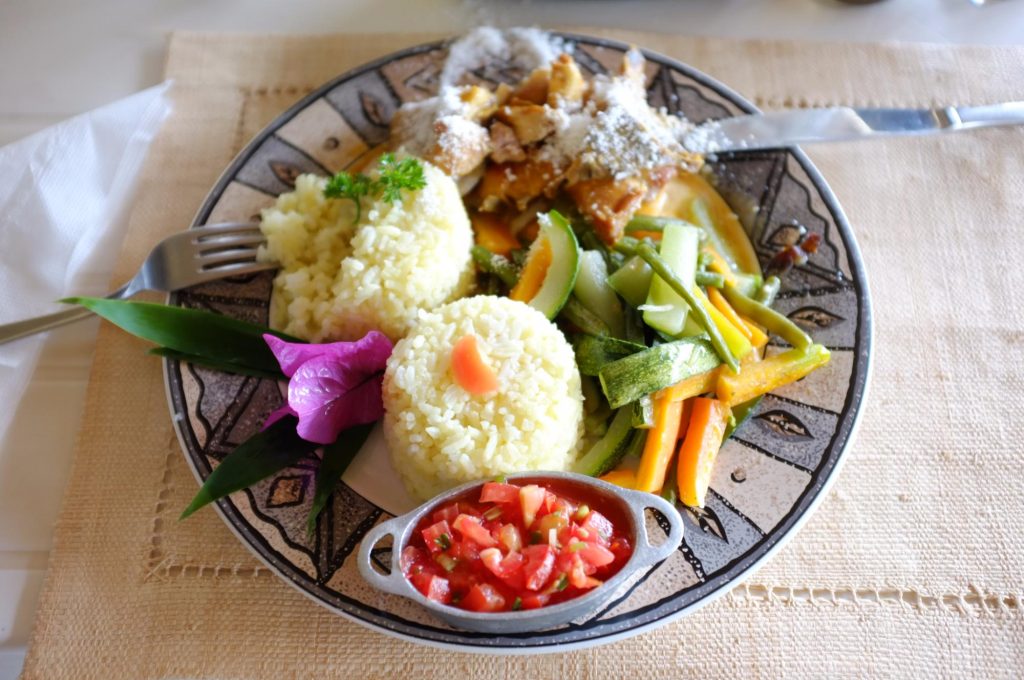
Rice with laoka is the staple everywhere and the cheapest filling option. Seafood on the coast is excellent and inexpensive. Zebu steak appears on most menus. Bottled water is a constant expense and should be budgeted, since tap water is not drinkable.
Where costs rise is in remote lodges, several of which include compulsory half board because there is nowhere else to eat. Setam Lodge at Ranomafana and the Masoala peninsula properties both work this way, and the meal cost is built into the room rate.
Domestic Flights and When They Are Worth It
Domestic flights are expensive relative to everything else in Madagascar and often worth it anyway. A flight to Morondava, Fort Dauphin, Nosy Be, Sambava or Maroantsetra saves one to three days of hard driving each way.
For Fort Dauphin the calculation is straightforward: the overland route takes around three days and official advice recommends flying. For Maroantsetra and Masoala there is no practical road alternative at all. For Morondava and Toliara, driving is possible but consumes most of a week in return transfers.
Book early. Routes run at limited frequency and sell out in peak season, and flight capacity constrains Madagascar itineraries more than hotel availability does.
Money, Cash and the Malagasy Ariary
The Ariary is a closed currency, meaning you cannot obtain it before arriving and should spend or exchange it before leaving. Change money at the airport or a bank rather than with street changers, who offer poor rates.
Cards work at larger hotels and some restaurants in the main cities and almost nowhere else. Park offices, guides, porters, taxi-brousse, markets and small guesthouses are all cash. ATMs exist in regional centres but withdrawal limits are low and machines run empty.
Carry more cash than feels comfortable when heading to remote areas, and keep it in separate places. Tipping guides, drivers and porters is customary and not built into quoted rates, so budget for it separately.
Where Travellers Overspend
Three patterns account for most avoidable expense. The first is booking a four-wheel drive for a route that does not need one, which happens often on the RN7 where a standard vehicle is fine.
The second is inefficient routing. Doubling back to Antananarivo between regions burns vehicle days and flights that a better-sequenced itinerary avoids. Combining Ankarana with the Red Tsingy on the same drive south, or catching the Avenue of the Baobabs going out and coming back, costs nothing extra.
The third is treating remote parks as day trips. Driving six hours each way to spend three hours somewhere is the most expensive way to see it, and usually means missing the dawn and dusk activity that justified the trip.
Frequently Asked Questions
How much does two weeks in Madagascar cost?
Aggregated traveller data puts a two-week trip at roughly 1,550 US dollars per person covering accommodation, food, local transport and sightseeing, excluding international flights. Budget travellers using taxi-brousse and guesthouses spend considerably less, around 45 to 60 dollars a day. Operator-arranged trips with a private vehicle and driver commonly run 150 to 280 dollars per day. International flights typically add 1,100 to 1,450 dollars return.
What does national park entry cost?
Most parks charge 45,000 Ariary per adult per day with children under twelve at 25,000. Tsingy de Bemaraha is 55,000 plus a compulsory 5,000 helmet fee, Lokobe is 55,000, Tsingy de Namoroka around 65,000 and Baie de Baly substantially higher at roughly 120,000, reflecting boat transfers and tortoise protection costs. Guide fees are separate, charged per group by circuit, and typically run 15,000 to 40,000 Ariary.
What is the biggest expense?
Transport, by a wide margin. One documented four-week trip for two spent about £3,454 on vehicle hire against £675 on accommodation across the same period. Reducing vehicle days through better routing saves far more than downgrading hotels.
Can I travel Madagascar on a tight budget?
Yes, on the main routes. Taxi-brousse connects the towns cheaply, guesthouses are inexpensive and park fees are modest. A shoestring trip runs around 45 to 60 dollars a day. What this cannot cover is the western circuit to Tsingy de Bemaraha or the remote northwest parks, which require four-wheel drive hire or charter transport with no cheap alternative.
Are domestic flights worth the cost?
Usually. They save one to three days of driving each way, and for Fort Dauphin, Maroantsetra and Masoala there is no practical road alternative. Book early, since limited frequency means they sell out in peak season and constrain itineraries more than accommodation does.
How much cash should I carry?
Enough for all park fees, guides, porters, meals and incidentals until your next bank. ATMs are scarce outside regional centres and absent entirely at places like Bekopaka, Soalala and Manantenina. Withdrawal limits are low and machines run empty, so draw in stages rather than relying on one visit.
Should I tip?
Yes, and budget for it separately. Guides, drivers, porters and cooks all expect tips, and these are not included in posted rates or operator quotes. In parks where a specialist tracker improves your chances of seeing a rare species, the tip matters as much as the fee.
Is Madagascar cheaper than mainland Africa?
On the ground, considerably. Accommodation, food and park fees all cost less than equivalent safari destinations in eastern or southern Africa. The offset is that vehicle hire and domestic flights are proportionally expensive, and the distances involved mean you use more of both. Total trip costs end up closer than the daily rates suggest.
Planning Your Trip
The useful budget question in Madagascar is not how cheap your hotel is but how many vehicle days your route requires. Sequencing parks so the driving does double duty, and flying the legs where a road transfer would eat three days, saves more than any other decision available to you.
Booking Your Madagascar Trip
The safari companies and tour operators listed on this website put trips like this together for a living and know which camps, guides and routes actually deliver. We are an independent guide to Madagascar; we do not book or sell tours ourselves.
When you are ready, arrange your safari, tour or holiday with one of the recognised operators listed here. Tell them your dates and what matters most, and a real person, not a form, will handle the itinerary, park bookings and logistics for you.