10-Day Madagascar Itinerary

A 10-day Madagascar itinerary covers one circuit properly rather than three badly, and for most first-time visitors that means the RN7 south from Antananarivo to Toliara. The route takes in highland towns, two rainforest parks, ring-tailed lemurs and the canyons of Isalo, ending at the coast. Ten days is the realistic minimum for the country, since road speeds and domestic flight frequency constrain everything.

Why the RN7 Works Best in Ten Days
The RN7 is Madagascar’s only long sealed road, running roughly 950 km from the capital to Toliara. That matters more than any scenic argument. Everywhere else in the country, the roads are the constraint on what fits into a trip.
Along the way it passes through several distinct systems: the highland plateau, the eastern rainforest edge at Ranomafana, dry deciduous forest at Zombitse, the sandstone canyons of Isalo and finally the spiny country before the coast. Few routes anywhere compress that much variation into one drive.
Travelling it one way and flying back from Toliara saves two full days of retracing. That single decision is what makes ten days work rather than feel rushed.
Ten days in Madagascar buys you one circuit done properly. Attempting north and south in the same window means spending most of it in a vehicle.
Days 1 and 2: Antananarivo and Andasibe-Mantadia
Arrive at Ivato and stay the first night in the capital. Long-haul arrivals land tired and the sensible move is not to drive anywhere on day one.
On day two, head east on the RN2 to Andasibe-Mantadia National Park, three to four hours away. This is a detour from the RN7 proper and it is worth every hour, because Andasibe gives the most reliable indri sightings in Madagascar and the indri is the animal most people come to see.
Walk a morning circuit in Analamazaotra, then do a night walk at VOIMMA or Mitsinjo in the community forest, since the national park itself closes in the afternoon. Two nights here is better than one if you can find the days.
Days 3 and 4: Antsirabe and the Highlands
Return toward the capital and turn south on the RN7 to Antsirabe, roughly three hours from Tana. This is Madagascar’s spa town, built by the French at 1,500 metres, with wide colonial avenues and several thousand hand-pulled pousse-pousse rickshaws.
A half day covers the town: a rickshaw tour, the thermal baths, the artisan workshops turning zebu horn into cutlery and recycled tin into miniature bicycles. Lake Tritriva, a collapsed volcanic crater 17 km west, fills an afternoon.
Continue south the following day toward Ranomafana, a long drive of six to eight hours through the highlands. Ambositra en route is the centre of Zafimaniry woodcarving and makes a natural lunch stop.
Days 5 and 6: Ranomafana National Park
Ranomafana is the rainforest highlight of the southern circuit, holding twelve lemur species including the golden bamboo lemur discovered here in 1986. The forest is steep, wet and dense, and sightings take more work than at Andasibe.
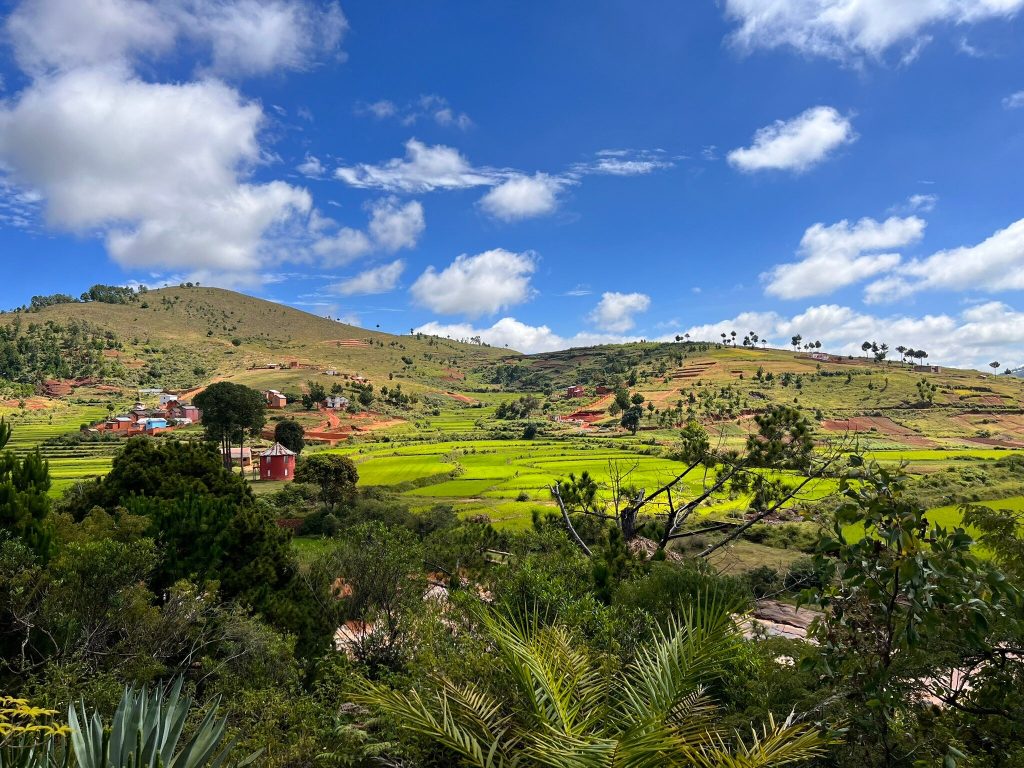
Walk a morning circuit with a guide, ideally asking for one working the bamboo lemur groups if that species matters to you. The night walk happens along the road outside the park boundary and turns up mouse lemurs, chameleons and frogs.
Two nights lets you do a full-day circuit rather than the short Varibolomena loop, and gives you a second morning, which is when the forest is most active. The thermal pool in the village is the reward after a muddy day.
Days 7 and 8: Ambalavao, Anja and Isalo
Drive south to Ambalavao, stopping at the Antemoro paper workshop where bark is pounded into pulp and pressed with dried flowers, and at the zebu market if you hit a Wednesday or Thursday.
Anja Community Reserve sits 13 km further on and takes ninety minutes. It holds the densest ring-tailed lemur population in Madagascar, in forest beneath three granite domes, and is entirely village-owned and run. Go early, before the coaches arrive.
Continue to Isalo National Park, four to five hours on. Spend day eight walking, either the Piscine Naturelle circuit to a spring-fed pool or the Namaza gorge with its waterfalls, then catch sunset at the Fenêtre de l’Isalo, the natural sandstone window.
Start walks at first light throughout this itinerary. In the rainforest parks the wildlife is active at dawn and quiet by mid-morning. At Isalo the exposed plateau becomes punishing by eleven. The single biggest improvement you can make to any Madagascar trip costs nothing and involves setting an alarm.
Days 9 and 10: Zombitse, Toliara and the Coast
Drive southwest toward the coast, stopping at Zombitse-Vohibasia National Park, a short walk directly off the RN7 that takes an hour or two and turns up Appert’s tetraka, a bird found in this forest and almost nowhere else.
Arrive at Toliara and transfer straight to the coast. The city has no swimming beach worth the name, so head north to Ifaty or Mangily, where a reef sits 200 metres offshore and snorkelling starts from the beach.
Day ten is the coast, either snorkelling, visiting the Antsokay Arboretum with its 900 endemic plant species, or simply resting after nine days of driving. Fly back to Antananarivo from Toliara rather than driving.
Alternative Ten-Day Routes
The RN7 is the default and not the only option. Two alternatives suit different travellers.
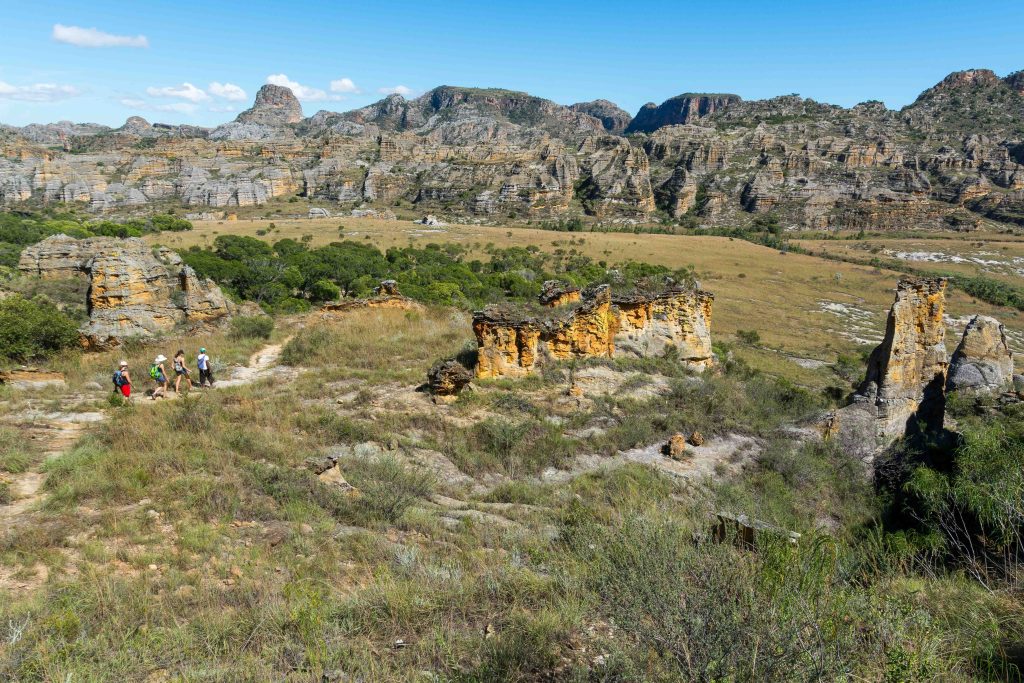
The northern circuit. Fly to Diego Suarez. Amber Mountain rainforest, Ankarana tsingy and caves, the Red Tsingy, the Emerald Sea, then Nosy Be for reefs. Shorter driving distances than anywhere else in the country and the widest habitat range in a small area. Better if you want beaches and less time in a vehicle.
The western circuit. Fly to Morondava. Avenue of the Baobabs, Kirindy Forest for fossa, and the hard road north to Tsingy de Bemaraha. The most dramatic scenery in Madagascar and the most demanding travel. Dry season only, and tight in ten days.
Combining Andasibe with the northern circuit also works, since both are reached by air or short drive from the capital. What does not work is attempting the RN7 and the north in the same ten days.
Realistic Driving Times on the RN7
Distances mislead badly in Madagascar. The RN7 is sealed but narrow, winding through highlands with trucks, livestock and roadworks, and average speeds run well below what the kilometres suggest.
Antananarivo to Antsirabe is three to four hours for 170 km. Antsirabe to Ranomafana runs six to eight hours. Ranomafana to Isalo is another long day. The full route to Toliara covers roughly 950 km and takes the better part of a week with stops.
Night driving is genuinely dangerous and should be avoided. Plan to arrive before dark every day, which means starting early and accepting that a delay early in the day compounds through it.
What This Itinerary Leaves Out
Ten days on the RN7 misses a great deal, and being honest about that helps set expectations.
You will not see baobab forests, since the Avenue of the Baobabs and Kirindy are on the western circuit. You will not see tsingy, which requires either the western route to Bemaraha or the north to Ankarana. Whale watching at Sainte-Marie, the Masoala rainforest and the silky sifaka at Marojejy are all elsewhere entirely.
Fourteen days lets you add a coastal stay or a second region. Three weeks covers two circuits. A month is what it takes to see the country properly, and even then travellers report leaving things out.
Frequently Asked Questions
Is ten days enough for Madagascar?
Enough for one circuit done well, not enough for the country. Ten days on the RN7 gives you highlands, two rainforest parks, ring-tailed lemurs and canyon country, ending at the coast. Travellers wanting baobabs, tsingy and whales as well need three weeks or more. Anything under a week should focus on Andasibe plus one other destination.
What does a ten-day trip cost?
Park fees run 45,000 Ariary per adult per day at most parks with guides charged separately per group. Accommodation ranges from 20 to 40 US dollars for guesthouses up to 60 to 120 for comfortable hotels. The dominant cost is the vehicle and driver, charged per day regardless of distance covered, plus the return flight from Toliara. Operator-arranged trips commonly run 150 to 280 dollars per person per day all in.
Should I drive myself or hire a driver?
Hire a driver. Self-drive is possible on the RN7 and some travellers do it, but road conditions, police checkpoints, navigation and the general difficulty of the country make a local driver good value rather than a luxury. Most rental agencies supply cars with drivers as standard.
Can I do this itinerary in reverse?
Yes, and flying to Toliara and driving north to Antananarivo works equally well. Some travellers prefer it because the arrival at the coast is replaced by an arrival in the highlands, and because flight availability sometimes favours one direction. The parks and stops are the same either way.
When should I do this trip?
April to November. October is the strongest month, with infant lemurs, active reptiles and settled weather. July and August are cooler and busiest. Avoid January to March, when rain makes the secondary roads difficult and several parks elsewhere in the country close outright.
Is Andasibe worth the detour?
Yes. It sits east of the capital rather than on the RN7, which adds a day, but it delivers the most reliable indri sightings in Madagascar. Skipping it means leaving without seeing the animal most associated with the country. If your ten days are truly fixed, cut a night at Antsirabe rather than Andasibe.
How much walking is involved?
Moderate. Park circuits run from ninety minutes at Anja to a full day at Ranomafana or Isalo, on trails that are steep and muddy in the rainforest and hot and exposed in the canyons. Nothing is technical, but boots with real grip make a substantial difference, and the Isalo walks need reasonable fitness.
What should I book in advance?
Domestic flights first, since they run at limited frequency and sell out in peak season, constraining itineraries more than hotels do. Then lodges at Andasibe, Ranomafana and Isalo, which fill months ahead from July to October. Park fees are paid in cash on arrival and cannot be booked.
Planning Your Trip
The decision that shapes a ten-day Madagascar trip is committing to one circuit. Travellers who try to add a second region end up with a driving holiday punctuated by short park visits, which is the most common regret reported from trips to this country.
Booking Your Madagascar Trip
The safari companies and tour operators listed on this website put trips like this together for a living and know which camps, guides and routes actually deliver. We are an independent guide to Madagascar; we do not book or sell tours ourselves.
When you are ready, arrange your safari, tour or holiday with one of the recognised operators listed here. Tell them your dates and what matters most, and a real person, not a form, will handle the itinerary, park bookings and logistics for you.