Endemic Mammals of Madagascar

Beyond the lemurs, Madagascar holds three groups of mammals found nowhere else: the tenrecs, small insectivores that have radiated into forms resembling hedgehogs, shrews and otters; the euplerid carnivores including the fossa; and a set of endemic rodents including the giant jumping rat. All descend from a handful of ancestors that reached the island by sea and evolved in isolation.
How Madagascar’s Mammals Arrived
Madagascar separated from Africa around 165 million years ago and from India roughly 88 million years ago, long before modern mammals existed. Everything here arrived later, across open ocean.
The evidence points to a small number of colonisation events, probably on rafts of vegetation washed out by rivers. Lemurs came from one, the carnivores from another, the tenrecs from a third and the endemic rodents from a fourth.
Each founding population then radiated into the niches available, with no competition from the groups that dominate continental Africa. There are no monkeys, no cats, no antelope, no elephants and no rodents of the families found everywhere else.
The result is a mammal fauna that looks superficially familiar and is related to almost nothing you would expect. A fossa resembling a puma is a mongoose relative; a tenrec resembling a hedgehog is not remotely related to one.
Four founding populations crossed the Indian Ocean on driftwood and produced everything that lives here. No monkeys, no cats, no antelope, and nothing that would look out of place has any business being here.
Tenrecs and the Insectivores
The tenrecs are the most striking case of adaptive radiation among Madagascar’s mammals, with over thirty species evolved from one ancestor into forms resembling hedgehogs, shrews, moles and otters.
The lowland streaked tenrec is the one visitors most want to see, black and yellow with barbed quills and a set of specialised spines on its back that it rubs together to produce sound, communicating with its young by stridulation in a way no other mammal does.
The common tenrec is the largest, reaching the size of a small rabbit, and produces litters that can exceed twenty young, among the largest of any mammal.
Hedgehog tenrecs curl into a ball when threatened and look convincingly like hedgehogs on entirely separate ancestry. Shrew tenrecs occupy the leaf litter, and the aquatic tenrec hunts in streams in the eastern rainforest.
Most are nocturnal and turn up on night walks at Ranomafana, Andasibe and Masoala, often as a surprise rather than a target. Several species hibernate through the cool dry season and are absent in practice from June to August.
The Euplerid Carnivores
Ten carnivore species live in Madagascar and all belong to the Eupleridae, descended from mongoose-like ancestors that arrived once and diversified.
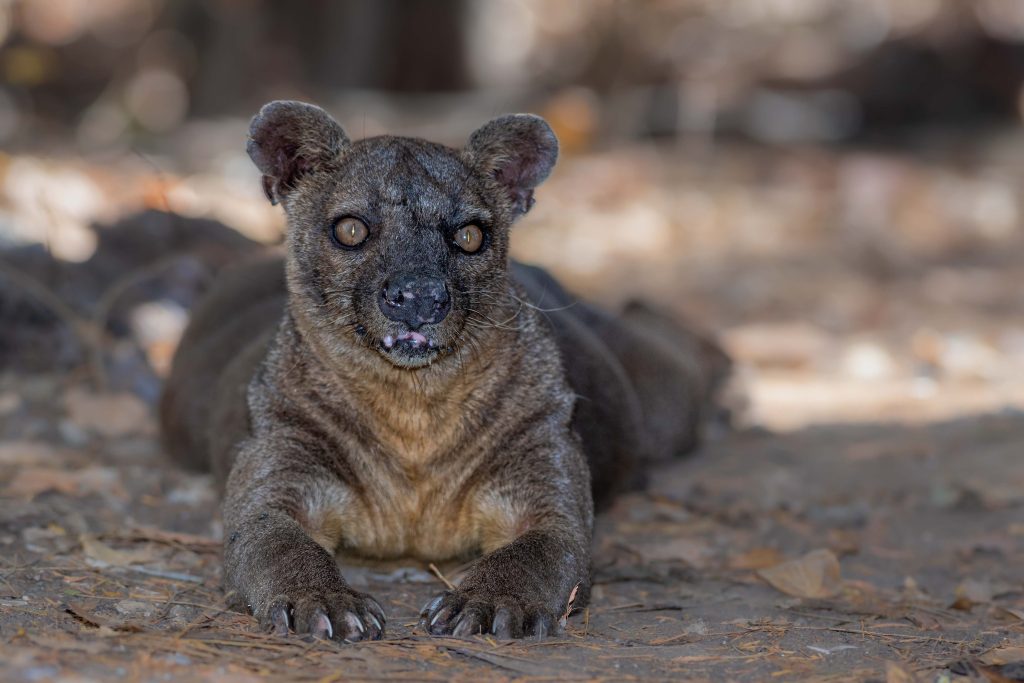
The fossa is the largest, cat-like and about the size of a small puma, hunting lemurs through the canopy with semi-retractable claws and ankles that rotate to allow head-first descent. Kirindy Forest is the one place with realistic odds, particularly during the October and November mating season.
The fanaloka, or Malagasy civet, is spotted and fox-like, found in eastern rainforest including Ranomafana, where guides occasionally locate one on night walks.
The falanouc is a slender long-snouted insectivore recorded at Masoala and rarely seen anywhere. The ring-tailed mongoose is the most visible of the group, reddish with a banded tail, active by day at Ranomafana and Ankarana.
Grandidier’s mongoose is restricted to Tsimanampetsotsa and its immediate surroundings, boldly marked and inquisitive enough that overnight visitors sometimes get good views. The narrow-striped mongoose occurs in western dry forest including Kirindy.
Realistically seen. Ring-tailed mongoose at Ranomafana and Ankarana by day. Fossa at Kirindy Forest with an overnight stay. Giant jumping rat at Kirindy at night. Tenrecs on night walks in the wet months.
Rarely seen. Fanaloka, narrow-striped mongoose, Grandidier’s mongoose. Present at specific parks and encountered by luck rather than planning.
Almost never seen. Falanouc, aquatic tenrec, and several rodents known mainly from surveys. Recorded at Masoala and the eastern rainforests, and a sighting would be an event.
The Giant Jumping Rat and Endemic Rodents
Madagascar’s rodents belong to the Nesomyinae, another endemic radiation, and the giant jumping rat is the one worth planning around.
Hypogeomys antimena, called vositse locally, is roughly rabbit-sized, moves in hops rather than running, and can launch itself close to a metre when startled. It lives in burrows, pairs for life, and occurs only in a small area of western dry forest.
Kirindy Forest Reserve is where visitors see it, since the animals visit the camp area at night and lodge staff will wake guests when one appears. It is endangered, with a range measured in a few hundred square kilometres.
Other endemic rodents include tuft-tailed rats and the Malagasy giant rat, most of them nocturnal, forest-dwelling and known mainly from surveys rather than tourist sightings.
Bats and the Flying Foxes
Around forty bat species occur in Madagascar with a high proportion endemic, and the largest are easy to see.
Madagascar flying foxes, Pteropus rufus, roost in large noisy colonies and are the most visible. The mangroves at Kirindy Mite hold a substantial roost worth timing a pirogue trip around, and Berenty has the largest colony in the south, hanging in daylight where they can be watched and photographed without difficulty.
Insectivorous bats fill the caves. Ankarana’s Grotte des Chauves-Souris holds colonies numbering in the hundreds, and the cave systems at Anjohibe and Namoroka hold others.
Several species are endemic to single regions, and the caves at Ankarana and Namoroka are where researchers concentrate. For visitors the flying fox roosts are the accessible sighting.
The Extinct Megafauna
Madagascar’s mammal fauna was considerably stranger within the last two thousand years, and the losses shape how the surviving species live.
Subfossil remains recovered from the caves at Ankarana include giant lemurs: sloth lemurs that hung from branches like their South American namesakes, and Megaladapis, a koala-like animal the size of a large dog. Some giant lemur species reached the size of a gorilla.
Alongside them lived giant tortoises, pygmy hippopotamuses and the elephant bird, the heaviest bird that ever lived, whose eggs are still occasionally found in fragments in the south.
All disappeared within roughly the last thousand to two thousand years, following human settlement. The debate over hunting versus habitat change continues, and the practical consequence is that Madagascar’s surviving fauna is a remnant of something considerably richer.
Most of Madagascar’s endemic mammals beyond the lemurs are nocturnal, which means night walks are where you see them. Tenrecs, the giant jumping rat, fanaloka and most rodents appear only after dark. Several tenrec species also hibernate through the cool dry season, so a June to August trip will miss them entirely regardless of how many night walks you do.
Introduced Mammals and What They Displaced
Not everything with fur in Madagascar belongs here, and the introductions have consequences worth knowing.
Zebu cattle arrived with human settlement and now number in the millions, central to Malagasy culture, wealth and funerary practice. They also drive the grazing pressure that prevents baobab seedlings establishing and keeps cleared land from regenerating.
Domestic dogs and cats have gone feral across much of the island and prey on lemurs, tenrecs and ground-nesting birds. Introduced rats compete with endemic rodents and carry disease.
The Asian house shrew and the black rat are both widespread and both implicated in declines among endemic small mammals, particularly in disturbed forest near settlements.
Bush pigs occur across the island and are hunted, and their status as native or introduced has been debated. Whatever the answer, they are one of the few larger mammals a visitor might come across that is not endemic.
Where to See Madagascar’s Endemic Mammals
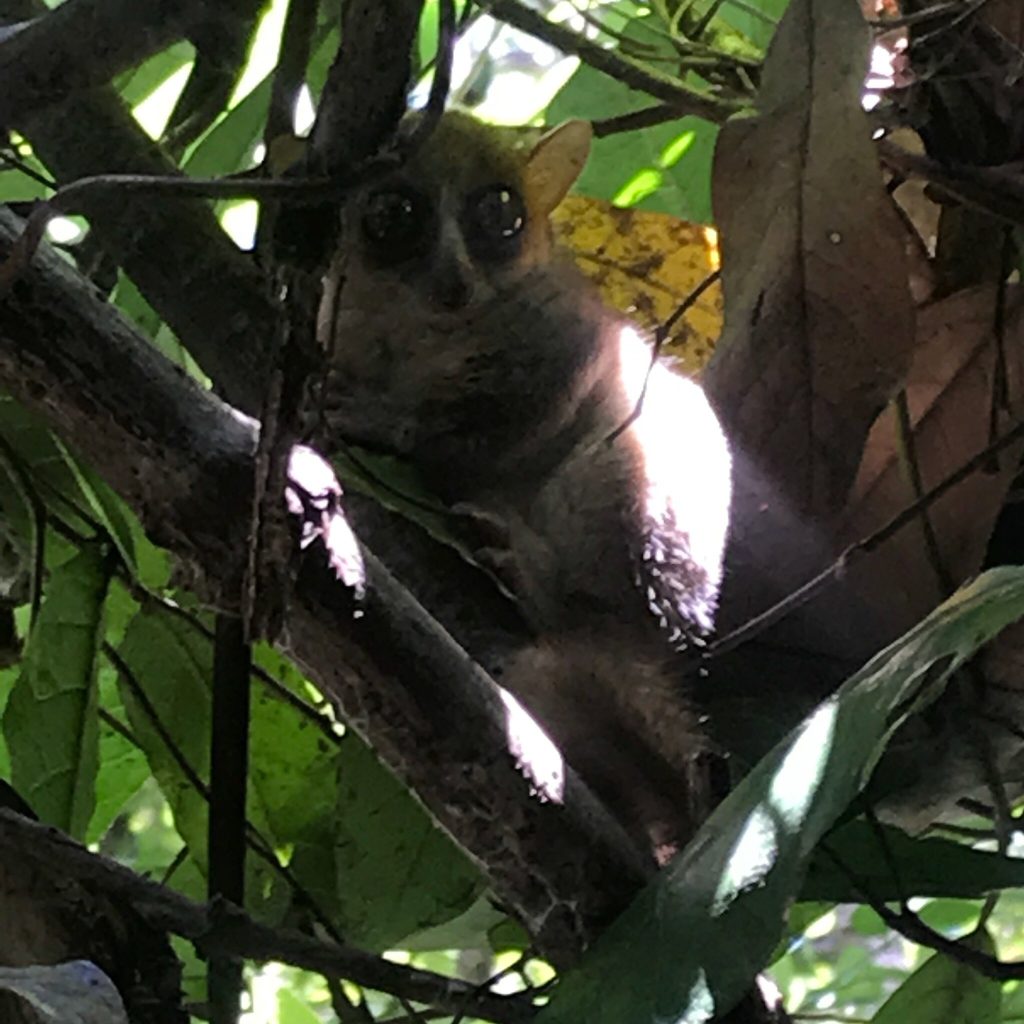
Kirindy Forest is the single strongest site, delivering fossa, the giant jumping rat, narrow-striped mongoose and Madame Berthe’s mouse lemur, with night walks inside the reserve because it is privately managed.
Ranomafana holds fanaloka, ring-tailed mongoose and several tenrec species alongside its twelve lemurs, with night walks on the park periphery.
Ankarana has ring-tailed mongoose, bat colonies in the caves and fossa recorded but rarely seen. Tsimanampetsotsa is the only realistic site for Grandidier’s mongoose.
Masoala holds falanouc, fanaloka and fossa across the largest protected area in the country, all of them scarce. Berenty and Kirindy Mite have the accessible flying fox roosts.
Frequently Asked Questions
What mammals live in Madagascar besides lemurs?
Three endemic groups: the tenrecs, over thirty species of small insectivores resembling hedgehogs, shrews and otters; the euplerid carnivores, ten species including the fossa, fanaloka and several mongooses; and endemic rodents including the giant jumping rat. Plus around forty bat species with a high proportion endemic.
What is a tenrec?
A small insectivore belonging to a group found only in Madagascar and parts of mainland Africa, which has radiated into forms resembling hedgehogs, shrews, moles and otters while being unrelated to any of them. The lowland streaked tenrec communicates by rubbing specialised spines together, which no other mammal does.
Where can I see the giant jumping rat?
Kirindy Forest Reserve north of Morondava, which is the only site worth planning around. The animals visit the camp area at night and lodge staff will wake guests when one appears. It is rabbit-sized, moves in hops, pairs for life and is endangered with a range of only a few hundred square kilometres.
Are these animals easy to see?
Mostly not. The ring-tailed mongoose is active by day and turns up at Ranomafana and Ankarana. Fossa and the giant jumping rat are realistic at Kirindy with an overnight stay. Tenrecs appear on night walks in the wet months. The falanouc, fanaloka and several mongooses are seen by luck rather than planning.
When is the best time?
November through March for tenrecs, since several species hibernate through the cool dry season and are absent from June to August. October and November for fossa at Kirindy, during the mating season. The giant jumping rat is active year-round at Kirindy, though the reserve is unreachable from mid-January to late March.
What happened to the giant lemurs?
They disappeared within roughly the last thousand to two thousand years, following human settlement. Subfossil remains from the caves at Ankarana include sloth lemurs and Megaladapis, a koala-like animal the size of a large dog, alongside giant tortoises, pygmy hippos and the elephant bird. The debate over hunting versus habitat change continues.
Are there any dangerous mammals?
None. The fossa is the largest carnivore at around twelve kilograms and avoids people entirely. Madagascar has no large predators, no dangerous snakes and nothing that threatens a walker. Nile crocodiles occur in some rivers and lakes, which is the one genuine caution and why guides direct where swimming is safe.
Where should I go to see the widest range?
Kirindy Forest for fossa, giant jumping rat, narrow-striped mongoose and Madame Berthe’s mouse lemur, with night walks inside the reserve. Ranomafana for fanaloka, ring-tailed mongoose and tenrecs. Between them they cover most of what a visitor can realistically hope to see beyond the lemurs.
Planning Your Trip
Madagascar’s non-lemur mammals reward the same two decisions as everything else here: night walks at every stop, and travelling in the warmer months when tenrecs and reptiles are active. Kirindy Forest is the one site worth building an itinerary around if these animals are the priority.
Booking Your Madagascar Trip
The safari companies and tour operators listed on this website put trips like this together for a living and know which camps, guides and routes actually deliver. We are an independent guide to Madagascar; we do not book or sell tours ourselves.
When you are ready, arrange your safari, tour or holiday with one of the recognised operators listed here. Tell them your dates and what matters most, and a real person, not a form, will handle the itinerary, park bookings and logistics for you.