Ambositra and Zafimaniry Woodcarving

Ambositra sits on the RN7 between Antsirabe and Fianarantsoa and is the centre of Zafimaniry woodcarving, a tradition recognised by UNESCO as intangible cultural heritage. Geometric patterns cut into furniture, panels and house frames define the style, and the villages where it originates lie in forested hills east of the town. Most travellers stop for an hour on the drive south.
The Zafimaniry Tradition
The Zafimaniry are a subgroup of the Betsileo living in around a hundred villages in the forested highlands east of Ambositra.
Their woodcraft covers everything: house frames, doors, window shutters, posts, stools, chests and utensils, all cut with geometric patterns whose motifs carry meaning rather than being decorative alone.
The designs draw on natural and cosmological references, and different patterns are associated with different purposes and positions in a building. Guides who know the tradition will read them for you.
UNESCO inscribed the Zafimaniry woodcraft knowledge on its intangible cultural heritage list, recognising both the skill and its precariousness.
That precariousness is the point. The tradition depends on forest that is disappearing, and the timber the carvers need is harder to obtain each decade.
A carving tradition recognised by UNESCO, dependent on forest that is going. The Zafimaniry problem is Madagascar’s problem in miniature.
Ambositra and the Workshops
Ambositra itself is the commercial centre for the craft, with workshops and shops along the main street selling carved panels, boxes, furniture and marquetry.
The town is not where the tradition lives, but it is where most of it is sold, and the quality ranges from genuine Zafimaniry work to mass-produced items aimed at passing traffic.
Asking to see the workshop behind the shop separates the two. Carvers work on the premises at several places and watching the cutting is more interesting than the finished object.
Marquetry, inlaid work using different coloured woods, is a related craft strongly associated with the town.
Prices are negotiable and lower than in Antananarivo. The convention at craft markets is to open around sixty percent of the asking price and settle near seventy-five.
Visiting the Zafimaniry Villages
The villages east of Ambositra are where the tradition actually operates, and reaching them takes commitment.
Antoetra is the most accessible, around 40 km from Ambositra on rough track, and is where most organised visits go. It sees enough visitors to have adapted somewhat.
Beyond Antoetra, villages including Ifasina and others are reached on foot, with treks of anywhere from a few hours to several days across forested hills. Guides are arranged in Ambositra or Antoetra.
What you see is houses built entirely without nails, joined and pegged, with carved shutters and posts. The buildings are the craft rather than objects made for sale.
Village stays are possible on the longer treks, with accommodation basic and arrangements informal. This is genuine community tourism rather than a packaged experience.
An hour in Ambositra. Workshops and shops on the main street, watching carvers work, buying panels or boxes. What most RN7 travellers do, and it works as a lunch stop between Antsirabe and Ranomafana.
A day or more to the villages. Antoetra by rough track, or trekking beyond it to villages reached on foot. Houses built without nails, carved shutters and posts, and the tradition in the place it belongs to.
The Geometry and What It Means
Zafimaniry carving is built from a small vocabulary of geometric motifs repeated and combined, and the patterns are not decorative in the way they first appear.
Rosettes, chevrons, lozenges and concentric forms recur across shutters, doors, posts and household objects. Individual motifs carry associations with family, ancestry, the natural world and social relationships, and craftsmen work them in combinations that mean something to the community rather than to a buyer.
The tradition uses no nails. Timber is jointed and pegged, which is part of why the work is recognised as craftsmanship rather than ornament, and why a piece can be dismantled and rebuilt.
Different woods serve different purposes, chosen for hardness, grain and workability, and a carver will explain which is which if asked.
UNESCO inscribed the woodcraft knowledge of the Zafimaniry on its intangible cultural heritage list, recognising the whole body of practice rather than any single object or building.
The Forest Problem
The Zafimaniry tradition exists because of forest and is threatened by its loss, which makes it a legible example of a pattern visible across Madagascar.
Highland forest has been reduced severely by clearing for agriculture and charcoal, and the hardwoods the carvers use are increasingly scarce and expensive.
Younger carvers work with what is available, which is not always the timber the tradition specifies. Some knowledge attaches to particular species and their properties, and that knowledge loses its object when the species goes.
Ambohitantely Special Reserve northwest of Antananarivo protects one of the last surviving patches of highland forest, a fragment of what once covered the plateau. It gives a sense of what has been lost across the region.
Buying from carvers directly rather than through shops keeps more of the money with the people maintaining the skill, which is the argument for stopping at a workshop rather than a roadside stall.
Ask to see the workshop behind the shop. Ambositra’s main street sells everything from genuine Zafimaniry work to mass-produced items made elsewhere, and the difference is not obvious from the finished object. Watching someone cut a panel takes ten minutes, tells you what you are buying, and is more interesting than the shopping.
Marquetry and the Wider Craft
Ambositra produces more than the Zafimaniry carving itself, and the town’s workshops turn out marquetry and inlaid work that draws on the same geometric vocabulary.
Boxes, panels, chess sets and furniture inlaid with contrasting woods fill the shops along the main street, and much of it is made in workshops behind them where the work can be watched.
Quality varies considerably. Pieces made for volume sale use softer woods and simpler patterns, while work commissioned or made carefully uses harder timber and finer jointing.
Prices in Ambositra are lower than Antananarivo and considerably lower than at coastal tourist markets, which makes this the sensible place on the RN7 to buy wooden goods.
Raffia work, basketry and textiles are also sold, and the Saturday market brings produce and crafts from the surrounding villages.
Ambositra as an RN7 Stop
The town sits roughly midway between Antsirabe and Fianarantsoa, on the longest driving leg of the southern circuit.
Antsirabe to Ranomafana runs six to eight hours, and Ambositra is the natural place to break it. Most travellers stop for lunch and an hour in the workshops before continuing.
The town has basic accommodation for anyone wanting to stay, which is worth considering for travellers heading to the Zafimaniry villages since those need a full day at minimum.
Altitude here is around 1,300 metres and the highland climate applies, with cold nights from June to August.
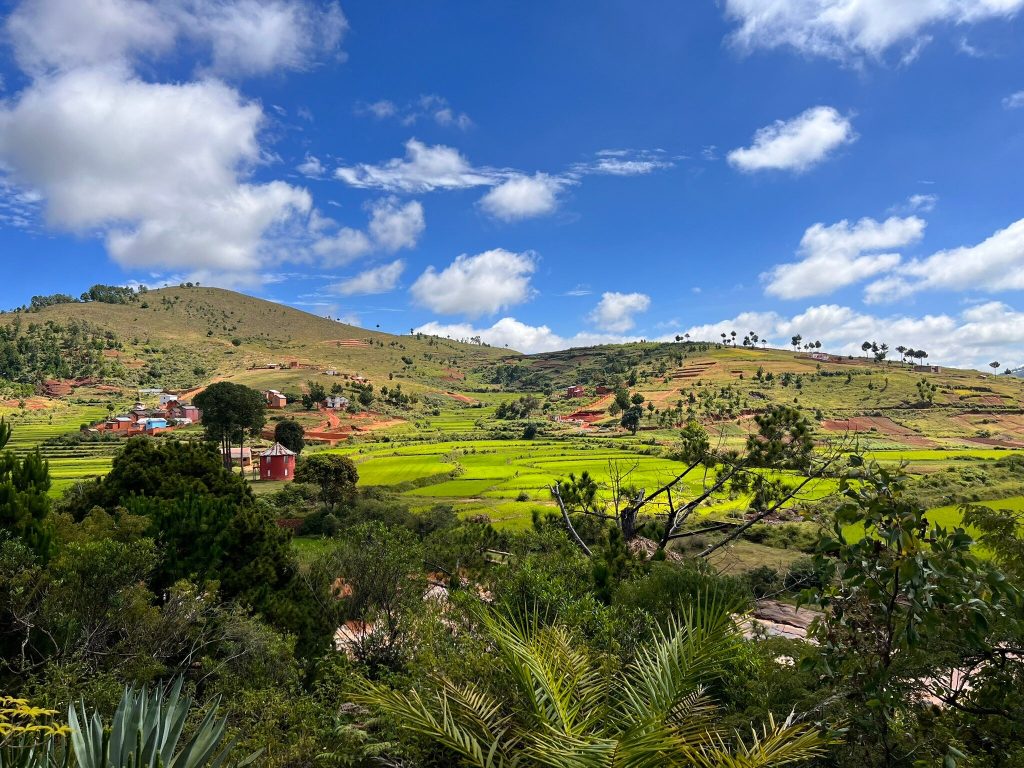
The country around is terraced rice and eucalyptus, with the forested hills holding the Zafimaniry villages rising to the east.
What to Buy and What to Check
Carved panels, boxes, chess sets, marquetry and small furniture are the standard purchases, and prices are considerably below Antananarivo.
Rosewood and other protected timbers are prohibited from export, and this matters at a woodcraft centre more than anywhere else. Illegal logging of rosewood and ebony from the northeastern parks is a documented problem and buying products made from them contributes to it.
Ask what the wood is. Reputable workshops will tell you, and anything described as rosewood should be declined regardless of what a seller claims about its legality.
Size matters for practical reasons too, since domestic flights impose lower baggage allowances than international carriers and the small aircraft to Sambava, Maroantsetra and Morondava are stricter still.
Payment is cash in Ariary. Cards are not accepted at workshops.
Frequently Asked Questions
What is Zafimaniry woodcarving?
A carving tradition of the Zafimaniry, a Betsileo subgroup living in forested highlands east of Ambositra, covering house frames, doors, shutters, posts and utensils cut with geometric patterns that carry meaning rather than being decorative alone. UNESCO has inscribed the knowledge on its intangible cultural heritage list.
Where is Ambositra?
On the RN7 roughly midway between Antsirabe and Fianarantsoa, at around 1,300 metres. It is the natural place to break the six to eight hour leg between Antsirabe and Ranomafana, and most travellers stop for lunch and an hour in the workshops.
Can I visit the Zafimaniry villages?
Yes. Antoetra is the most accessible at around 40 km from Ambositra on rough track. Beyond it, villages including Ifasina are reached on foot with treks from a few hours to several days. Guides are arranged in Ambositra or Antoetra, and village stays are possible with basic accommodation.
How do I know if the carving is genuine?
Ask to see the workshop behind the shop. Ambositra’s main street sells everything from genuine Zafimaniry work to mass-produced items made elsewhere, and the difference is not obvious from the finished object. Watching someone cut a panel takes ten minutes and tells you what you are buying.
What should I not buy?
Anything made from rosewood or other protected timbers, which are prohibited from export. Illegal logging of rosewood and ebony from the northeastern parks is a documented problem and buying these products contributes directly to it. Ask what the wood is, and decline anything described as rosewood.
How much does it cost?
Considerably less than Antananarivo. Prices are negotiable, with the convention at craft markets being to open around sixty percent of the asking price and settle near seventy-five. Payment is cash in Ariary, since workshops do not take cards.
Why is the tradition threatened?
It depends on forest that is disappearing. Highland cover has been reduced severely by clearing for agriculture and charcoal, and the hardwoods carvers need are increasingly scarce. Some knowledge attaches to particular species and their properties, and that knowledge loses its object when the species goes.
Is it worth more than an hour?
For most RN7 travellers an hour in the workshops is the right stop, breaking a long driving day. For anyone genuinely interested in the tradition, the villages east of Ambositra are where it lives, and reaching them needs a full day minimum or several for the trekking routes.
Planning Your Trip
Ambositra is a stop rather than a destination for most travellers, and the hour it takes is well spent on the longest leg of the RN7. For anyone wanting the tradition rather than the shopping, the villages east of the town are a different proposition and need days rather than an hour.
Booking Your Madagascar Trip
The safari companies and tour operators listed on this website put trips like this together for a living and know which camps, guides and routes actually deliver. We are an independent guide to Madagascar; we do not book or sell tours ourselves.
When you are ready, arrange your safari, tour or holiday with one of the recognised operators listed here. Tell them your dates and what matters most, and a real person, not a form, will handle the itinerary, park bookings and logistics for you.